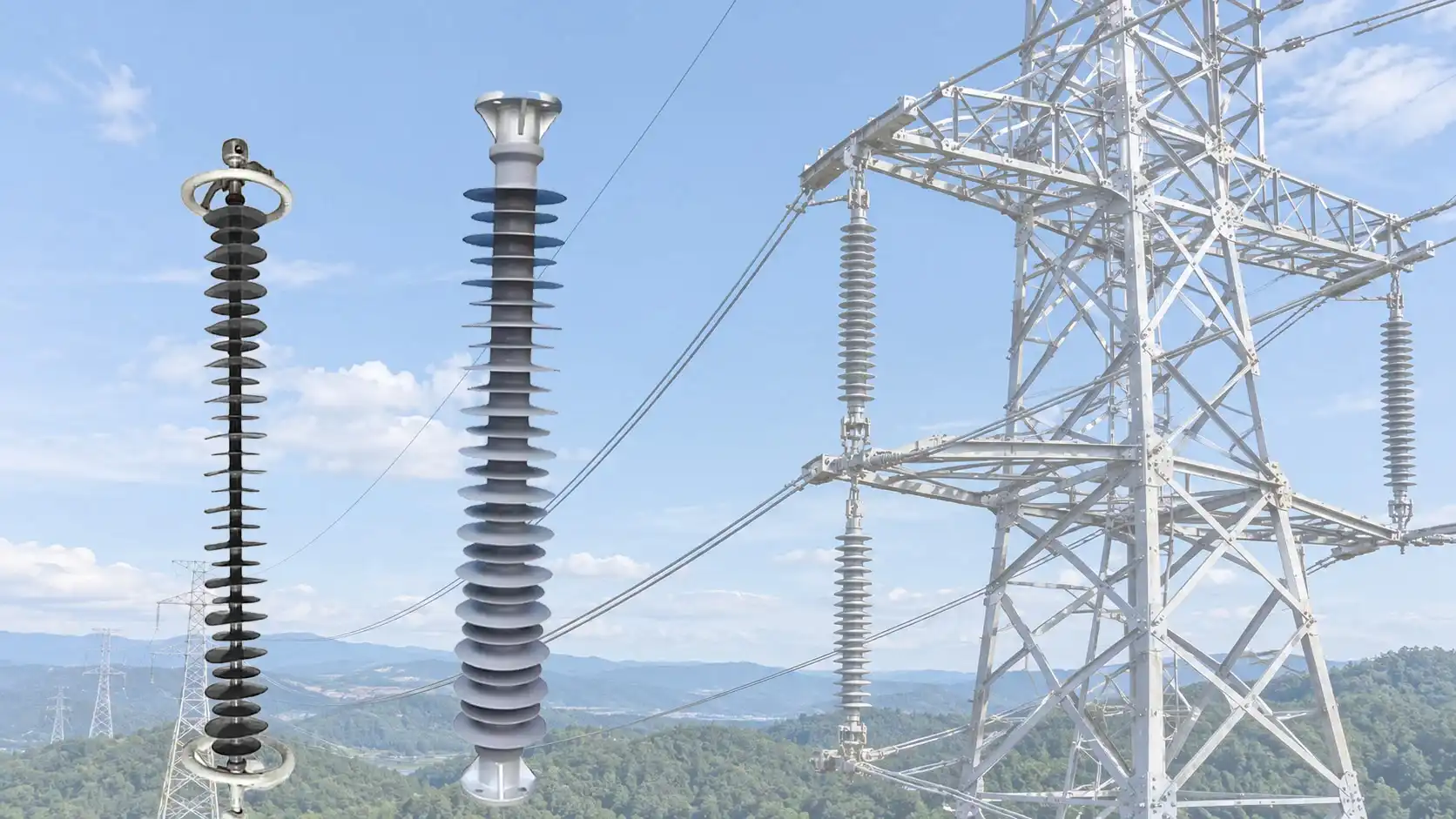
High-voltage overhead transmission lines traversing coastal salt-fog zones, heavy industrial corridors, and arid deserts face a severe operational threat: pollution flashover. When airborne sea salt, industrial chemicals, or conductive dust settle on insulator surfaces and absorb moisture from fog or dew, surface leakage currents rise rapidly. On conventional hydrophilic surfaces, these currents cause localized dry-band arcing, which can lead to catastrophic grid outages.
To prevent outages, utility engineers increasingly deploy polymeric suspension insulators. The primary defense of high-temperature vulcanized (HTV) silicone rubber is hydrophobicity transfer in composite insulators—a unique mechanism that keeps external insulation surfaces water-repellent even under thick contamination.
1.How the Hydrophobicity Transfer (HTM) Mechanism Works
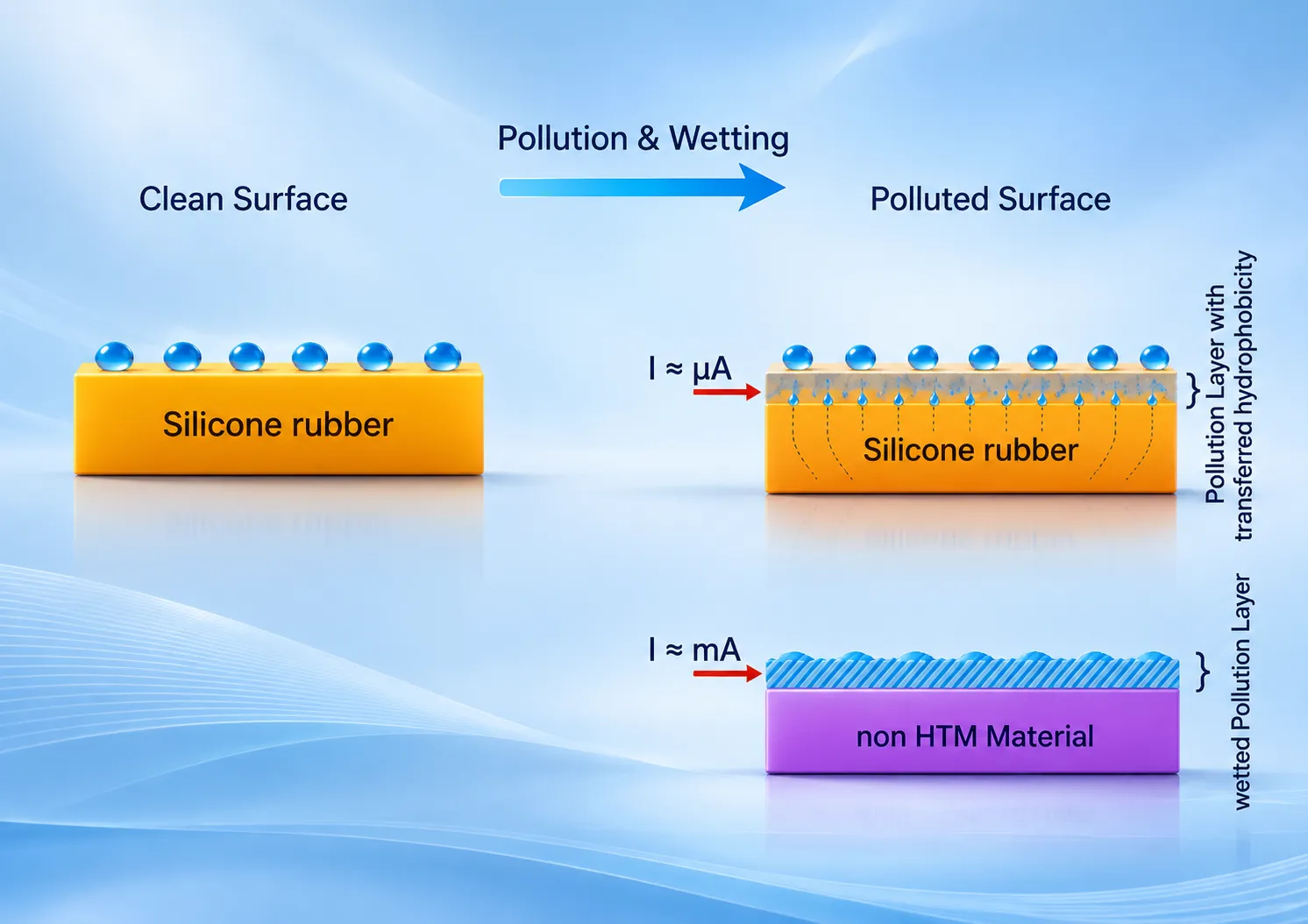
Unlike porcelain or glass, which form continuous conductive water films when wet, silicone rubber is inherently hydrophobic. Water separates into isolated beads, preventing conductive electrolytic channels from connecting.
Silicone rubber maintains water repellency on dirty surfaces through a clear physical process:
1.1LMW Silicone Reservoir and Capillary Migration
The vulcanized silicone matrix contains free, uncrosslinked Low Molecular Weight (LMW) silicone chains (PDMS oligomers). When airborne dust forms a contamination layer over the insulator shed, these LMW molecules migrate through the microscopic pores of the pollution layer to the outside surface.
1.2 Surface Passivation and Arcing Prevention
At the air-contaminant interface, non-polar methyl groups orient outward, covering the dirt with a thin, water-repellent molecular layer. Because water remains beaded, leakage current stays in the sub-milliampere range, stopping dry-band discharges from forming.
2.Engineering Benefits for Power Transmission Lines
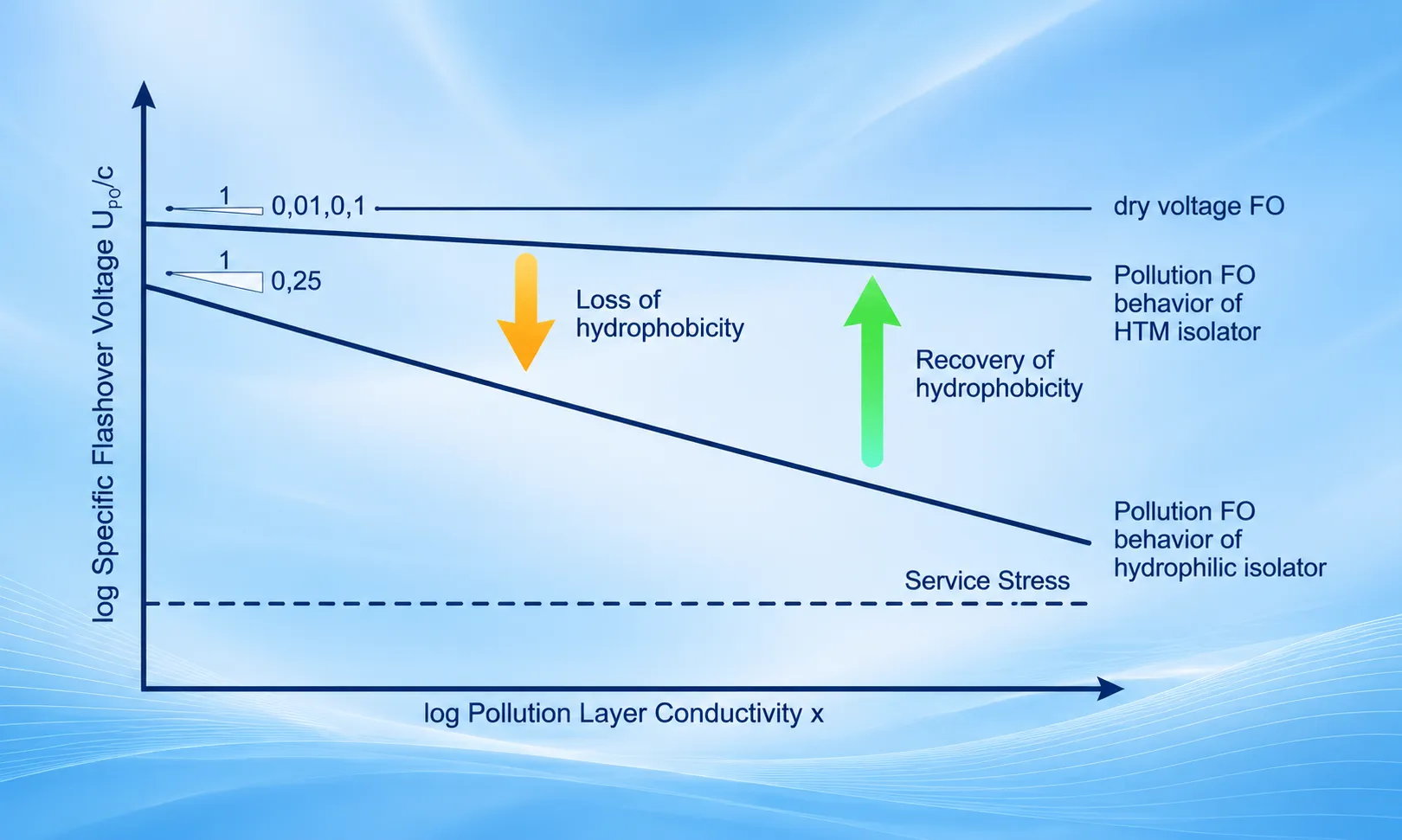
Under IEC 60815-3 (Selection and dimensioning of high-voltage insulators intended for use in polluted conditions), verified Hydrophobicity Transfer Materials (HTM) deliver clear structural and financial benefits:
2.1 Reduced Creepage Distance
HTM surfaces maintain flashover voltages significantly higher than non-hydrophobic materials. Transmission lines in heavy pollution areas can reduce total creepage distance by 15% to 20% compared to equivalent ceramic strings.
2.2 Structural and Maintenance Advantages
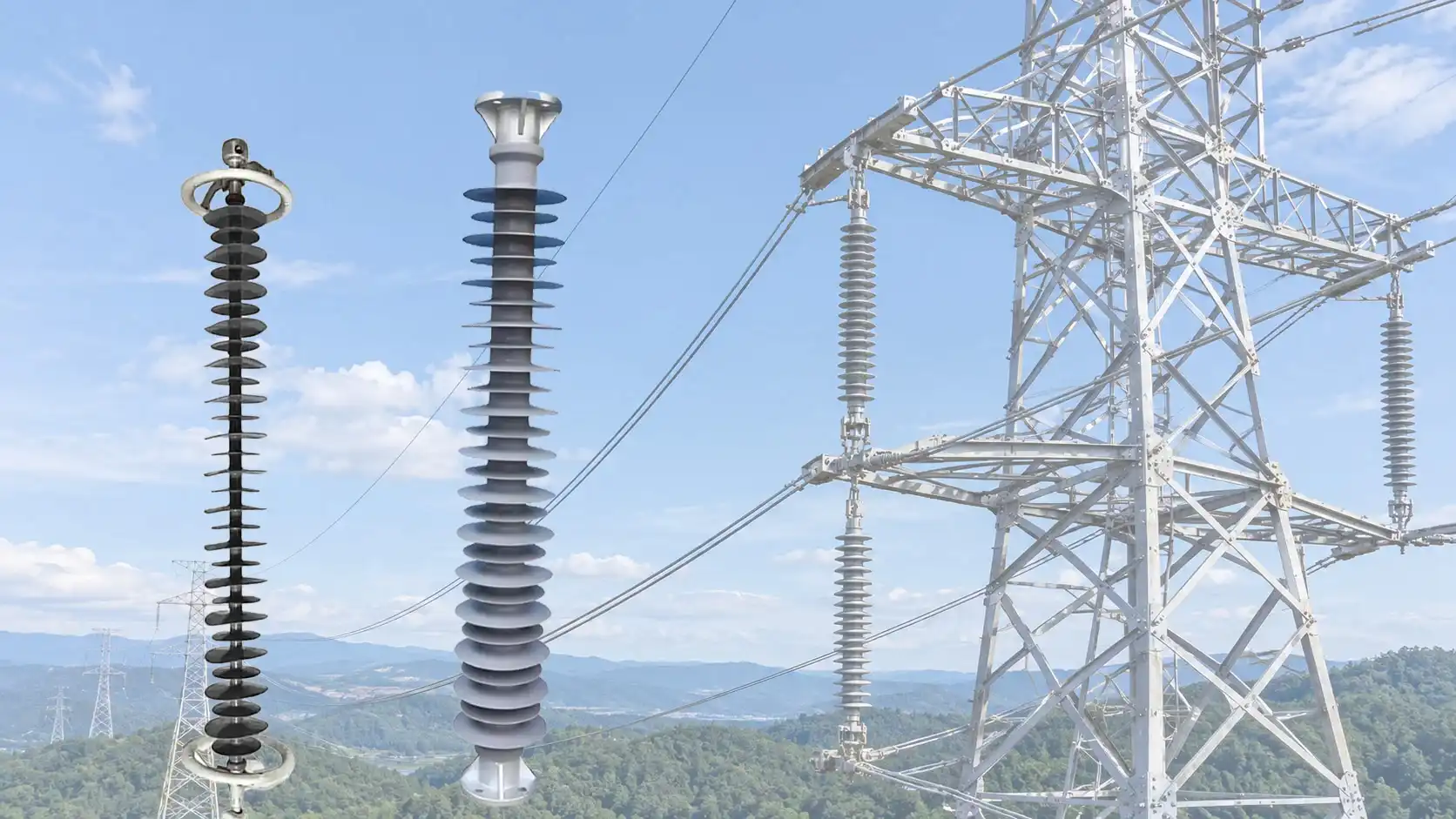
Tower Head Optimization: Shorter insulator assemblies allow for smaller tower cross-arm clearances, reducing tower structural steel weight and line construction costs.
Lighter Line Loads: Composite units weigh up to 80% less than porcelain strings, simplifying transport across mountainous terrain and speeding up installation.
Zero Line Washing: Eliminates regular line washing in arid desert and coastal areas, lowering annual grid maintenance costs.
3.Manufacturing Integrity: Preventing Brittle Fracture
Hydrophobic properties only provide reliable service if the core rod and end fittings are protected from environmental degradation. Gaoya Power uses three essential manufacturing controls:
3.1 Boron-Free ECR Core Rod
Pultruded with acid-resistant ECR fiberglass. Under electrical stress and moisture, standard E-glass can suffer stress corrosion cracking (brittle fracture). ECR glass rods prevent mechanical failure in acid-forming environments.
3.2 High-Pressure Seamless Injection
The HTV silicone housing is directly molded over the primed core rod in a single step, ensuring void-free bonding and preventing internal moisture tracking.
3.3 Multi-Axis Acoustic Emission Crimping
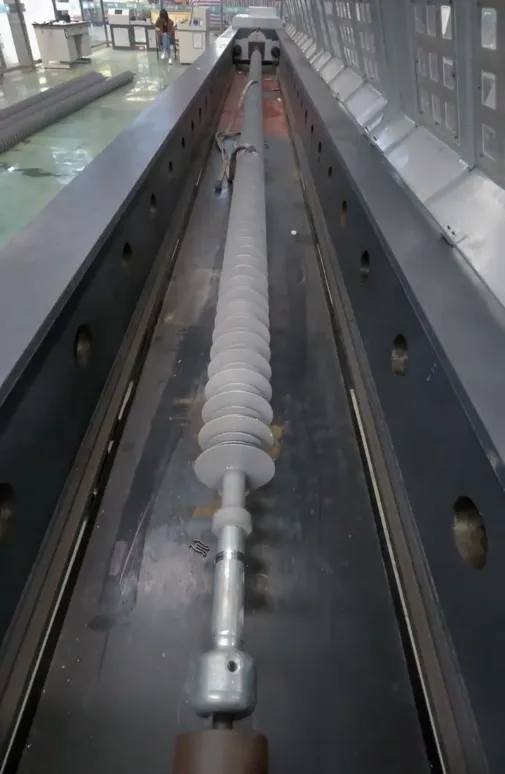
Forged steel end fittings (IEC 60120 ball & socket) are radially crimped with acoustic sensors to monitor crimping pressure, avoiding inner fiber damage while achieving Specified Mechanical Loads (SML) from 70 kN to 210 kN.
4.Gaoya Power FXB Series Specifications
Gaoya Power designs and manufactures composite suspension insulators for 11kV to 220kV transmission networks:
4.1 Electrical & Mechanical Ratings
Available Voltages: 11kV, 24kV, 33kV, 66kV, 110kV, 145kV, 220kV, 330kV, 500kV
Mechanical Ratings (SML): 70kN, 80kN, 100kN, 120kN, 160kN, 210kN
4.2 Hardware & Quality Standards
4.2.1 Shed Profile & Hardware Coupling
Shed Profile: Alternating aerodynamic shed profile for self-cleaning performance.
Hardware Standard: Hot-dip galvanized forged steel ANSI/NEMA C29.12.
4.2.2 Factory Testing Compliance
Tested in accordance with IEC 61109, IEC 60815, and ISO 9001 certified quality systems.
| Modelo | Tensión Nominal (kV) | Carga mecánica nominal de flexión (kN) | Altura estructural (mm) | Distancia mínima de arco (mm) | Distancia mínima de fuga (mm) | Tensión soportada al impulso de rayo, pico (kV) | Tensión soportada a frecuencia industrial 1 min en húmedo (kV) | Tamaño del Acoplamiento |
| FXB-11/70 | 11 | 70 | 330 | 160 | 300 | 95 | 45 | 16 |
| FXB-11/80 | 11 | 80 | 370 | 200 | 450 | 95 | 45 | 16 |
| FXB-24/70 | 24 | 70 | 410 | 240 | 750 | 125 | 65 | 16 |
| FXB-24/100 | 24 | 100 | 450 | 240 | 750 | 125 | 65 | 16 |
| FXB-24/120 | 24 | 120 | 450 | 240 | 750 | 125 | 65 | 16 |
| FXB-33/70 | 33 | 70 | 530 | 360 | 900 | 200 | 95 | 16 |
| FXB-33/80 | 33 | 80 | 590 | 425 | 1080 | 220 | 95 | 16 |
| FXBW-33/70 | 33 | 70 | 655 | 480 | 1260 | 220 | 105 | 16 |
| FXBW-33/100 | 33 | 100 | 695 | 480 | 1260 | 220 | 105 | 16 |
| FXBW4-66/70 | 66 | 70 | 870/940 | 710 | 2248 | 410 | 185 | 16 |
| FXBW4-66/100 | 66 | 100 | 870/940 | 710 | 2248 | 410 | 185 | 16 |
| FXBW4-110/100 | 110 | 100 | 1240/1440 | 1000/1200 | 3150/3860 | 550 | 230 | 16 |
| FXBW4-110/160 | 110 | 160 | 1340 | 1000 | 3380 | 550 | 230 | R20 |
| FXBW4-145/120 | 145 | 120 | 1480 | 1240 | 4123 | 725 | 355 | 16 |
| FXBW4-220/100 | 220 | 100 | 2240/2350/2470 | 2020/2080/2210 | 6450/6760/7150 | 1000 | 395 | 16 |
| FXBW4-330/160 | 330 | 160 | 2290 | 2600 | 9075 | 1425 | 570 | R20 |
| FXBW4-220/210(160) | 220 | 210/160 | 2350 | 2000 | 6800 | 1000 | 230 | R20 |
| FXBW4-330/210(160) | 330 | 210/160 | 2930 | 2650 | 8790 | 1425 | 570 | R20 |
| FXBW4-500/210(160) | 500 | 210/160 | 4450 | 4075 | 14860 | 2050 | 740 | R20 |
5.Technical Support and Line Design Inquiries
Gaoya Power provides complete tender support and technical documentation for utility grid upgrades and turnkey EPC transmission projects:
Type test certificates from recognized third-party laboratories
Tailored creepage distance and shed profile designs for extreme pollution environments
Detailed dimensional CAD drawings and technical data schedules (.pdf / .xlsx)
Contact Our Engineering Team:
WhatsApp: +86 13713715179
Email: [email protected]
Website: gaoyapowers.com